Last weekend we went to see a bout between the Birmingham Blitz Dames and Croydon Roller Derby. The Blitz Dames won. It was great.
Sunday, 1 April 2012
Anthotypes
Hi blog. My last post was of photos with snow in them so clearly it's been a while. I've got a few posts in mind to do, but I'll do them in order so the first one will be about Anthotypes.
I found out about them while searching for weird things to do with film to make it more interesting, like boiling it etc. and it was a really sunny day when I found this page about it, and it seemed pretty straight forward so I decided to have a go.
As that page explains, anthotypes are made by crushing up plants, adding water or alcohol and putting them through a sieve/cloth to get rid of bits and impurities. Then you paint that 'emulsion' on paper or whatever, let it dry in the dark, and then put them out in the sun with some kind of object over the top. The areas around the object turn pale and the area underneath stays the original colour. Here's a nice example of a good anthotype made with beetroot and a photo of a beetroot printed on acetate (by Nicky Thompson, obviously) and another one by art badger on Flickr:
I went and got a load of stuff from my Nan's garden, being as we have nothing in ours, and got mushing:
A few of them worked, a couple worked well (ish) and one was just rubbish from the start. Here's the grass one, which worked best. I only had to leave it out for a day.
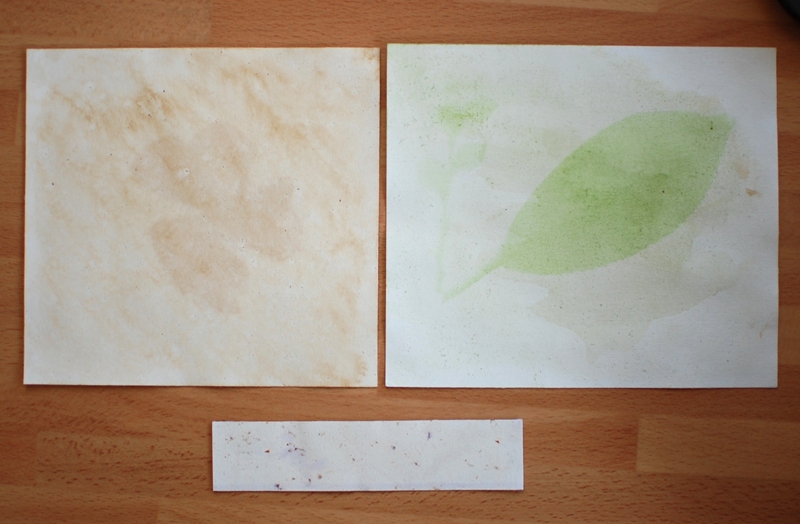
And the other few which didn't work quite as well. I quite like the leaf one but I put the 'emulsion' on a bit blotchy. The others just weren't very sensitive.
As my first attempt, they're very simple but I just wanted to try the technique. Now I've done it once I think I'll have another go with some more interesting shapes and just generally try to make them a bit better.
I found out about them while searching for weird things to do with film to make it more interesting, like boiling it etc. and it was a really sunny day when I found this page about it, and it seemed pretty straight forward so I decided to have a go.
As that page explains, anthotypes are made by crushing up plants, adding water or alcohol and putting them through a sieve/cloth to get rid of bits and impurities. Then you paint that 'emulsion' on paper or whatever, let it dry in the dark, and then put them out in the sun with some kind of object over the top. The areas around the object turn pale and the area underneath stays the original colour. Here's a nice example of a good anthotype made with beetroot and a photo of a beetroot printed on acetate (by Nicky Thompson, obviously) and another one by art badger on Flickr:
I went and got a load of stuff from my Nan's garden, being as we have nothing in ours, and got mushing:
A few of them worked, a couple worked well (ish) and one was just rubbish from the start. Here's the grass one, which worked best. I only had to leave it out for a day.
And the other few which didn't work quite as well. I quite like the leaf one but I put the 'emulsion' on a bit blotchy. The others just weren't very sensitive.
As my first attempt, they're very simple but I just wanted to try the technique. Now I've done it once I think I'll have another go with some more interesting shapes and just generally try to make them a bit better.
Friday, 10 February 2012
Thursday, 9 February 2012
Sunday, 5 February 2012
Flash experiments
This week we got the title for this new photography unit, and one of my ideas for it was to combine natural and man-made things, like photographing a plant with a bright flash and that sort of thing. Then after my interview at a university yesterday I looked at some of the work by the person who interviewed me and it just so happens that they've done a similar thing. (have a look here, in the still life section) So that inspired me to have my first attempt tonight, and this is an example of what I ended up with.
Subscribe to:
Posts (Atom)